PyEtSimul Documentation




PyEtSimul is an open-source Python framework for simulating video-based eye trackers by generating synthetic eye features through geometric modeling. The framework allows flexible positioning of eyes, cameras, and light sources in 3D space, with controlled variation of eye anatomical features and camera properties.
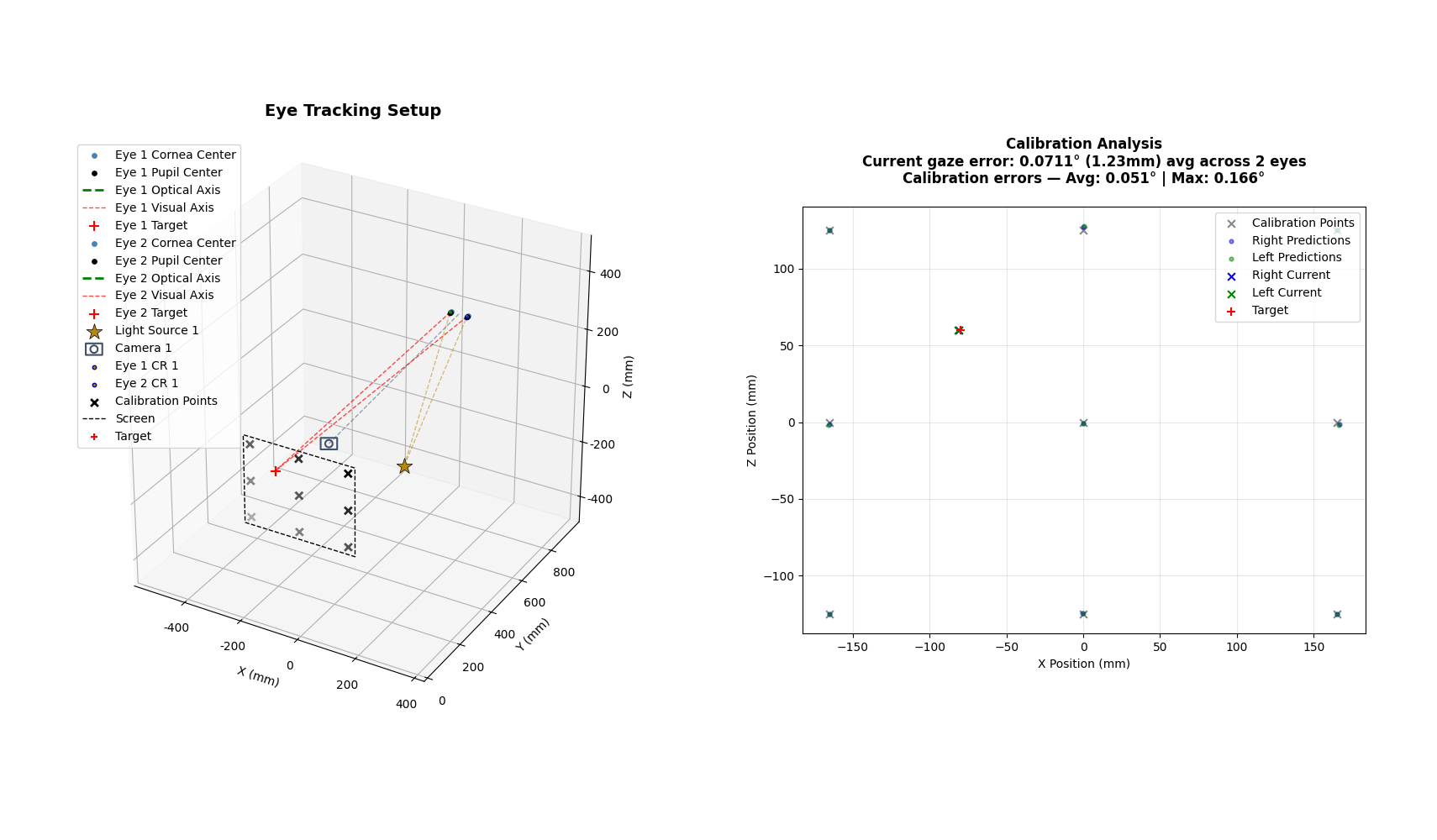
PyEtSimul’s core code is based on et_simul [1], but extends it by generalizing corneal modeling to conic surfaces rather than the common sphere, supporting non-circular pupil shapes, size-dependent pupil decentration, eyelid occlusion, and camera lens distortion. It also supports systematic data generation and principled comparison of gaze estimation algorithms across calibrated and uncalibrated settings.
Theory
Guides
API Reference
Note
The theoretical content in this documentation is derived from the PyEtSimul paper [2] by the same authors. If you use PyEtSimul in your research, please cite [2].
Note
This project has received funding from the European Union’s Horizon Europe research and innovation funding program under grant agreement No 101072410, Eyes4ICU project.